
Films about artists with macular degeneration
October 30, 2025
A scholar at a university in England recently asked us whether artists with macular degeneration use their peripheral vision to create their artwork. “Definitely,” I replied. It’s a question I might not have been able to answer so confidently if not for the many films about artists with macular degeneration working in their studios, beginning with those produced by The Vision & Art Project (V&AP) / The American Macular Degeneration Foundation (AMDF). These films—and others about low-vision artists—are incredibly valuable, not only because they portray artists’ methods and the adaptations they use to create visual works, but also because they depict artists’ complex lives, ambitions, and struggles that are not defined solely by their disability.
Furthermore, as painter Leslie Parke notes (Parke does not have macular degeneration but has been reflecting on “what happens when an artist’s vision changes”), films about blind artists offer a “kind of comfort” to artists like her who are considering the possibility of experiencing altered perceptual abilities, because they show “how perception itself can become the subject of art, whether on canvas or screen.”
For those interested in exploring the genre, here is a list of films about artists who have vision loss caused by macular degeneration, starting with four films produced by the V&AP / AMDF, including The Air Made Visible, about the kinetic artist Tim Prentice, which we have released on the occasion of his passing in November at the age of 95. We will update this list regularly.
Tim Prentice
“The Air Made Visible” (2024, 42 minutes)
Produced by AMDF, available to stream for free
This documentary was filmed and produced when Tim Prentice was in his nineties, as he worked in his studio and looked back on his career and the influences that shaped him. These included his fascination with the wind; the artists Alexander Calder and George Rickey; his time at Yale as an architecture student studying with Joseph Albers; his father, an aspiring craftsman and architect of note; and his loss of vision from macular degeneration. In the film, he talks about how, for him, the artistic process involved trying to still the din of voices, past and present, that surrounded him. Over his life, he strived to be “alone” with his work, free from the influences in his head, as he attempted to create an “ideal” work of art, one that, like nature, was at once ordered and chaotic.
For decades, Tim worked with a small crew of local craftspeople and artists who helped him realize the production of his diverse public and private works. One of his closest collaborators, David Colbert, eventually became his partner. David shares the spotlight with Tim in several scenes, and their interactions show both the depth of their partnership and their often-differing yet complementary views.
Towards the end of the film, Tim discusses having learned in 1996 that he had macular degeneration. At the time, he was in his mid-60s and had gone to the doctor for an annual eye exam, only to be told that he had an incurable eye condition that would likely leave him legally blind. Although his vision deteriorated over the years, he says it happened so gradually that he was hardly aware of it, except for glasses that became increasingly strong. When he worked, he relied as much on his sense of touch as his sight, tracing the wire assemblages with his fingers, feeling for inconsistencies and the character of soldered joints.
The Air Made Visible intertwines footage shot in recent years at Tim’s home and studio in Litchfield County, Connecticut, with footage of a younger Tim as shot by Zach Newcomb in his 2002 film, Finding Tim Prentice, and in casual footage shot by the photographer Jeffrey Milstein. Pivotal moments in Tim’s career, including his loss of vision to macular degeneration, are brought to life through animation done by Molly Schwartz and Lindsey Meyer-Beug of PHLEA TV. The film also contains historic footage from many of the large, commissioned public works Tim’s studio has done, juxtaposed with video footage of the natural world.
Lennart Anderson
“Seeing with Light”(2014, 13 minutes)
Produced by AMDF, available to stream for free
This 13-minute film about the perceptual painter Lennart Anderson was our first at the Vision & Art Project. Anderson suggested the title, “Seeing with Light.”
He was in his mid-eighties when we filmed him in his studio, at which point his vision was severely impaired. As a result, he worked less often from direct observation than he once had, though he still painted portraits of friends, who went to his studio to sit for him—”heads,” he called them.
When we made this film, he was painting his colleague, Kyle Staver. She posed for him for several weeks, and we filmed one of those sittings, capturing the unique details of their encounter.
Anderson began, like most artists who work from life, by comparing his painting to Kyle, shifting his gaze between the two. He leaned close to his palette, examining the paint piles just inches away. “Dammit,” he often muttered as he set his brush on the canvas, his eyesight making it difficult for him to tell if he had put it exactly where he wanted. Staver stared into the distance, neither moving nor breaking his focus. Her likeness ebbed and flowed on Anderson’s canvas, lost then found, corrected, and regained by the stroke of his thumb over wet paint or by the gentle motion of a bristle brush carefully pulled over his work, blending unwanted contours and discordant tonal passages.
In one of the most moving moments of our filming, Anderson moved closer to Staver at one point, peering through a magnifying glass at the folds of her eyes. “My God, it’s so beautiful,” he said. “I didn’t see that before. I just didn’t see that.”
Robert Andrew Parker
“A Is for Artist” (2019, 16 minutes)
Produced by AMDF, available to stream for free
Robert Andrew Parker showed early signs of macular degeneration in 2000, but he kept creating art, as he always had, until the end of his life.
Day after day in his Connecticut studio, filled with artifacts and interesting objects he collected from the town dump, he summoned onto paper and canvas the subjects that had long fascinated him: animals, planes, ships, landscapes, and the visual essence of poems he cherished. More than any other artist we have worked with, Parker’s vision loss did not seem to force him to make major changes in his working methods. Although he could not do the fine work of etching on a plate, he still managed to draw and paint with relative ease despite his vision loss, relying on quick, intuitive gestures, a vivid imagination, and a wealth of remembered visual details.
There is a beautiful moment in this film (whose musical score was composed by his son, the jazz musician Chris Parker) when, as Parker recites Bertolt Brecht’s “The Drowned Girl” from memory, he creates a watercolor in response to it.
Serge Hollerbach
“A Russian Painter in New York” (2021, about 25 minutes)
Produced by AMDF, available to stream for free
In this short, award-winning documentary filmed in Hollerbach’s studio on the Upper West Side of New York and its surroundings, the Russian émigré painter Serge Hollerbach creates two paintings separated by four years, during which he visibly ages and experiences a decline in his vision. While painting, he discusses art, his displacement during World War II, building a new life in New York City, and how vision loss has impacted his painting.
Hollerbach often said that macular degeneration freed him to pursue a vision more in keeping with his expressionistic roots. Featured in The New York Times in the summer of 2018 in connection with The Persistence of Vision exhibition we curated at the University of Cincinnati, he elaborated on this idea, stating about his post-macular work, “To be playful, you have nothing to lose. Nothing to lose is a new kind of freedom.”
Hollerbach’s sense of being “playful” and “free” is shown through several touching moments in this film, such as when he blocks in a scene based purely on body memory while describing what he sees on New York streets, when he picks up a homemade magnifier to look more closely at his linework, and when he steps back from his painting to wink at the camera. To finish his second, later painting, a woman who’d been his student years earlier helps him. One of my favorite parts of the film is watching them interact, including a moving moment when she takes his hand and guides it to the canvas to help him place his brush in the right spot, something that can be difficult for a painter with macular degeneration to judge.
James Morrison
“Eye of the Storm” (2021, 1 hr. & 18 mins.)
Directed by Anthony Baxter
Montrose Pictures
James Morrison is widely recognized as one of Britain’s top landscape artists. His work hangs in the homes of JK Rowling and the Royal Family, as well as in museums and private collections worldwide. As this documentary begins, Morrison faces what the filmmakers call one of his most significant challenges: his vision is deteriorating due to macular degeneration, and he wishes to complete a final painting. From his studio just outside Montrose, Scotland, Morrison admits, “The very thought of coming in here and not being able to pick up a brush and do something with it really terrifies me. It really appalls me.” Still, he allows filmmaker Anthony Baxter to follow him as he begins painting again at 85, after being sidelined by a series of surgeries. While doing so, he reflects on his extraordinary artistic career.
First released in the U.K. in 2021, Eye of the Storm has been broadcast on PBS Stations across the United States since 2024, thanks to the generous support of the American Macular Degeneration Foundation.
In the film, as Morrison begins painting again, he’s troubled by the fact that—on doctor’s orders—he can’t paint outdoors. His lifelong obsession with painting what he sees, en plein air, has taken him around the world—from Africa to Paris to Greenland. As Morrison returns to his studio, there’s a sense that time is running out. Along with his eyesight, his memory is also failing, and he has to look at a piece of paper in his pocket to recall the director’s name. A new solo exhibition of his work in Edinburgh—his 25th—is soon to open. Despite his declining eyesight, Morrison has promised the organizers one last piece. As he shuffles through half a dozen pairs of glasses, he expresses frustration at not being able to focus properly. He’s on the verge of quitting, gruffly insisting that: “I certainly will not send paintings from this studio if they are below an acceptable standard!” But to the accompaniment of a favorite piece of Beethoven, Morrison gives it one last try. As he begins painting on a pristine white board, he miraculously summons the energy of the brash young painter he once was, his brush flashing across the canvas, leaving behind grand waves of lapis lazuli.
As the film—and Morrison’s own artistic journey—comes to an end, there’s a final moment of triumph in Edinburgh. “Jim Morrison is a national treasure,” says the Scottish Gallery’s director Guy Peploe, as he opens what will be Morrison’s last solo exhibition. Peploe tells those gathered that he’s unsure if the artist, now very frail, will be able to attend. But then the artist arrives, in a wheelchair guided by his daughter Judith. As a smiling James Morrison greets his great-grandson and a crowd of admirers, he learns that one of his final paintings—Dark Landscape—has already sold. James Morrison would pass away a few months later, on August 31, 2020, at the age of 88.
Along with telling the story of his final painting, Eye of the Storm also recounts some key moments from Morrison’s remarkable career. This includes his training at the famous Glasgow School of Art in 1950 under the guidance of David Donaldson, a prominent figure in the Scottish art scene at the time, his attraction to landscape painters from an earlier era—such as Claude Lorrain, Jean-François Millet, and Scotland’s own Horatio McCulloch—and how Morrison’s search for meaning in the landscape ultimately led him to the most remote parts of the world—the high Arctic regions of Canada and Greenland.
Pivotal moments in Morrison’s career are brought to life by Scottish animator Catriona Black. Indeed, her own journey to understand Morrison’s artistic genius, in order to do justice to it in the film, represents a story within a story in this multi-layered and visually stunning documentary.
Eye of the Storm is a fascinating exploration of what it means to be a landscape painter. It also tells a heartfelt and universal story of a creative mind facing his own mortality and the physical frailties that catch up with all of us.
Available to rent at Montrose Pictures’ international distributor or on Amazon Prime.
Agnès Varda
Faces Places (2017, about 90 minutes)
Produced by Rosalie Varda
About five years before Agnès Varda passed away, her daughter, Rosalie Varda, introduced her to the photographer and visual artist known as JR. Despite their age difference, Varda and JR started working together on a film. Varda, who was then 87, could only spend one week each month traveling with JR. They didn’t necessarily plan to make a feature-length film, but two years after they began their project, in 2017, they released Faces Places to widespread acclaim. It was to be Varda’s second-to-last feature film and the only one she made in which she shared directorial credit.
During the making of Faces Places, Varda’s vision was impaired by macular degeneration. She also knew she didn’t have much time left (she died from breast cancer two years after Faces Places was released). Her worsening eyesight, looming death, past friendships, and early work—the inevitable passing of her embodied self—became one of the main themes of the film. To the haunting beauty of Matthieu Chedid’s music, Varda’s vulnerability shines through as the beating heart at the center of Faces Places, giving the film its depth and structure—a radical act of generosity by an artist whose humanistic approach has long been celebrated.
In one scene, for example, Agnès lies on a table on her back. Except for one eye, her face is covered with a blue sheet of paper. A medical professional, wearing protective gloves, attaches a metal eyelid holder to keep her eye open and prevent her from blinking. The doctor inserts a needle into the white part of her eye to give an injection. This is a common procedure for many people with wet macular degeneration to help stabilize their condition, usually done at regular intervals. The artists I know who get these injections dread them and often feel unwell for several hours afterward, and Varda admits to J.R. that she feels shaken after the procedure.
Ultimately, however, along with revealing Varda’s vulnerability, this film shows how, even though Varda’s retina is damaged by disease, she still sees. It’s in her ability to empathize with the people she encounters and her openness to letting chance play a role in the creative process. It’s in her capacity to imagine scenes that hold deep meaning. It’s in her tendency to free associate, play, imagine, invent, and share.
This movie is available to stream on several different channels, including Apple TV, the Criterion Channel, Google Play, and Amazon Prime.
“Robert Hamilton: Maine Master” (2001, 27 minutes)
One in a series of “Maine Master” documentaries about Maine artists
Produced by Kane Lewis under the auspices of the Union of Maine Visual Artists
By Carl Little, Robert Shetterly, and Deb Vendetti
In a humorous and engaging interview, Robert Hamilton, wearing an eyepatch, explains how he developed his “improvisational” approach to painting. After receiving a traditional education focused on the Old Masters, he aimed to create work that reflected his unique perspective, as he believed his major influences, such as Max Beckmann, Pablo Picasso, and Francis Bacon, had done. For him, that involved developing a jazz-inspired painting process. Allowing himself to be guided by intuition and chance, he experimented and “invented” stage-like “places” on his canvases where “something would occur.” Much to his surprise, jokes entered those spaces; instead of removing them, as he feels many artists would, he let them occupy the space and become part of his artistic voice.
He talks about his eyesight in the final moments of the film, when he is painting with a wearable magnifier. He explains that he has half of one eye left and wishes he had half of both, because if the vision in his working eye fails, he will be “left in the dark.” “I don’t know if there’s an hour that goes by that I don’t think about that,” he says. Despite his concerns, the film ends on an optimistic note when he says his new mantra is, “If you fall off a cliff, you may as well learn to fly.” It’s a fitting ending, since flight has always been a major theme for Hamilton, a decorated World War II fighter pilot.
Available to stream for $2.99 at Vimeo.
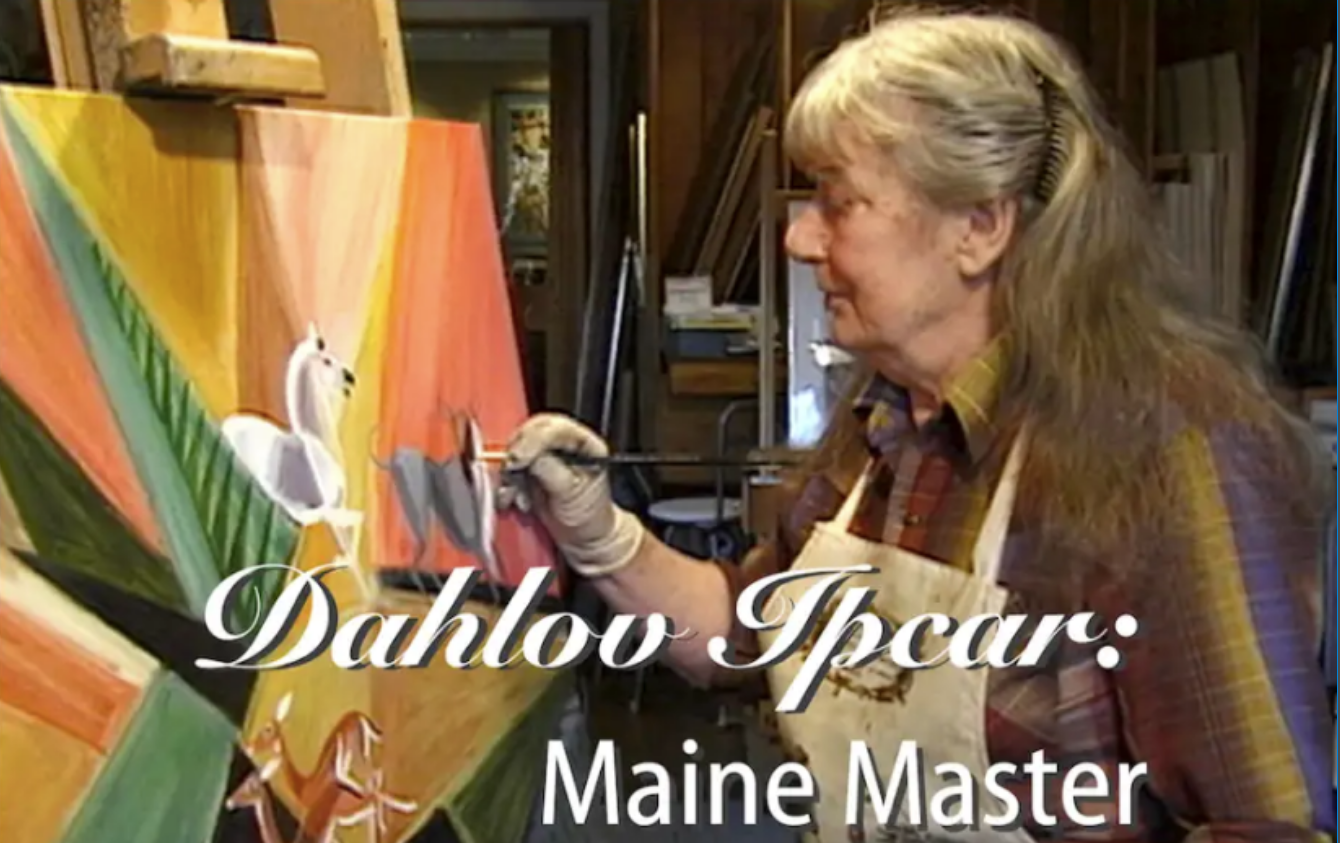
“Dahlov Ipcar: Maine Master” (2003, 27 minutes)
One in a series of “Maine Master” documentaries about Maine artists
Produced by Kane Lewis under the auspices of the Union of Maine Visual Artists
By Carl Little, Robert Shetterly, and Deb Vendetti
In this film, Ipcar, born in 1917, discusses growing up in the artistically rich environment of the Zorach home in Greenwich Village; how she developed her signature style of painting detailed, kaleidoscopic works featuring animals; the nineteenth-century lifestyle she and her family experienced after moving from New York City to Maine; and her philosophy of art, including her belief that artists should show “New worlds, new visions that you don’t just see outside your window” and that “Meaning has nothing to do with art.”
As discussed and shown in this film, Ipcar’s paintings of animals are incredibly intricate. Beginning in 2015, she would be unable to finish them due to a sharp decline in her eyesight caused by macular degeneration. However, as she revealed in an interview with the Vision & Art Project that year, she had been living with macular degeneration for many years. She kept it secret because she did not want her work’s reception to be affected by her vision loss.
Although she does not mention having macular degeneration in this film, she was 84 when it was made, and, based on what she told the V&AP, it is certainly possible her vision was already affected by the disease. At the very least, she was dealing with cataracts, which she mentions having just had removed at the time of filming, causing her to “tone down” her paintings, as she says, because they looked too brilliant to her.
Available to rent for $2.99 from Vimeo.
David Levine
Portraits of a Lady (2008, 40 minutes)
Directed by Neil Leifer
Produced by HBO
This documentary features painter and caricaturist David Levine, along with 24 other artists, as they create portraits of Supreme Court Justice Sandra Day O’Connor during a session with the Painting Group, which Levine and portraitist Aaron Shikler founded in the 1950s. Levine had been diagnosed with macular degeneration a year and a half earlier. While the film is not solely about him, one of its more prominent threads shows his efforts to paint O’Connor while coping with reduced visual acuity.
The Painting Group—initially formed so that the young Levine and Shikler could afford studio space—became known over the years as a place to learn from two master artists. In the first half hour of this 40-minute film, Levine critiques painters’ works-in-progress without showing any sign that his vision loss affects him. Midway through the film, though, Levine is seen having difficulty working on a drawing of O’Connor. He openly discusses his struggles since developing macular degeneration, which makes it hard for him to see clearly and forces him to generalize forms while switching between glasses with different magnifications to see at a distance and draw at arm’s length.
All the Painting Group’s portraits of O’Connor were showcased at the National Portrait Gallery in 2007. The final part of the film, which highlights the opening night of the exhibition, unintentionally exposes the stigma that an established artist can encounter when creating a different type of work while experiencing vision loss. Although she was informed that Levine had macular degeneration, O’Connor appears unaware that his portrait of her was influenced by it and that he relied on distortions inherent in caricature because it was familiar to him. “This one takes the beauty prize,” O’Connor sarcastically remarks about Levine’s portrait.
Other people also speak about the image in ways that reveal insensitivity to the circumstances in which it was created. Supreme Court Justice David Souter tells O’Connor, “Oh, that’s how I feel about you when you and I are dissenting.” Justice Stephen Breyer comments that the portrait “captures something about Sandra, but it’s not exactly what she looks like.” One of the few to understand the situation is Levine’s lifelong friend, Shikler, who states, “What [Levine] did was create something out of what he couldn’t see anymore, and that is what is exciting about it.”
No trailer available. Stream at Disney+, HBO Max, and Prime Video.

William Thon: Maine Master (2002, about 27 minutes)
One in a series of “Maine Master” documentaries about Maine artists
Produced by Kane-Lewis Productions under the auspices of the Union of Maine Visual Artists
By Carl Little, Robert Shetterly, and Deb Vendetti
Perhaps more than any other film on this list, the main subject and focus of this documentary, which was released a few years after William Thon’s death in 2000, is how one artist adapted to vision loss and kept painting. Born in New York City, William Thon had little formal art training beyond a brief stint at the Art Students League. Nevertheless, his art career gained momentum around 1942 when his painting East Wind was included in an Artists for Victory exhibition at the Metropolitan Museum of Art.
He received a Prix de Rome in 1947, followed by a fellowship from the American Academy in Rome, where he later served as a trustee and artist-in-residence. After returning to the United States, he and his wife settled in a home they built in Port Clyde, Maine. While living in Maine, he was represented by Midtown Galleries, a New York-based gallery, until the end of his career. He became a well-known mid-century American artist and, every few years, held exhibitions at Midtown that often sold out. By the end of his life, his work was in several important museum collections, including at the Met, and he had amassed a small fortune from his painting, most of which he donated to the Portland Museum of Art.
The film begins with him in his studio in Port Clyde, Maine. He stands at his painting table, surrounded by the cluttered, intentional chaos typical of many artists’ studios: a pile of paint-stained, crumpled paper towels on one side, old coffee cans filled with brushes, and more. Carl Little, who made the documentary, is present, talking to Thon as he paints a boat, explaining how he can do so despite seeing so much less than he used to.
Thon holds a powerful magnifying glass close to his eye, then bends down to examine the paper, which he sprays with water to prep it for the dark watercolor and black ink he has begun using in place of paint (he can no longer see color). On the paper, a boat appears on choppy water, done, he says, using intuition and memory. In commenting on the extraordinary effect of “evaporated matter” that Thon produces in his late, post-macular work, the art historian Susan C. Larsen says, “it is as if he was looking at the electric charges of living things, making the painting phosphoresce.” She, as well as his gallerist, saw a “cosmic understanding of nature” in his work, especially evident in his late black-and-white works.
One of the other people who discusses Thon in the film is his neighbor, who shares that when he asked Thon how long it took him to do a painting, Thon said, “That painting took 84 years.”
Available to stream for $2.99 at Vimeo.
Leave a Comment