
Hedda Sterne’s Quest
March 02, 2026
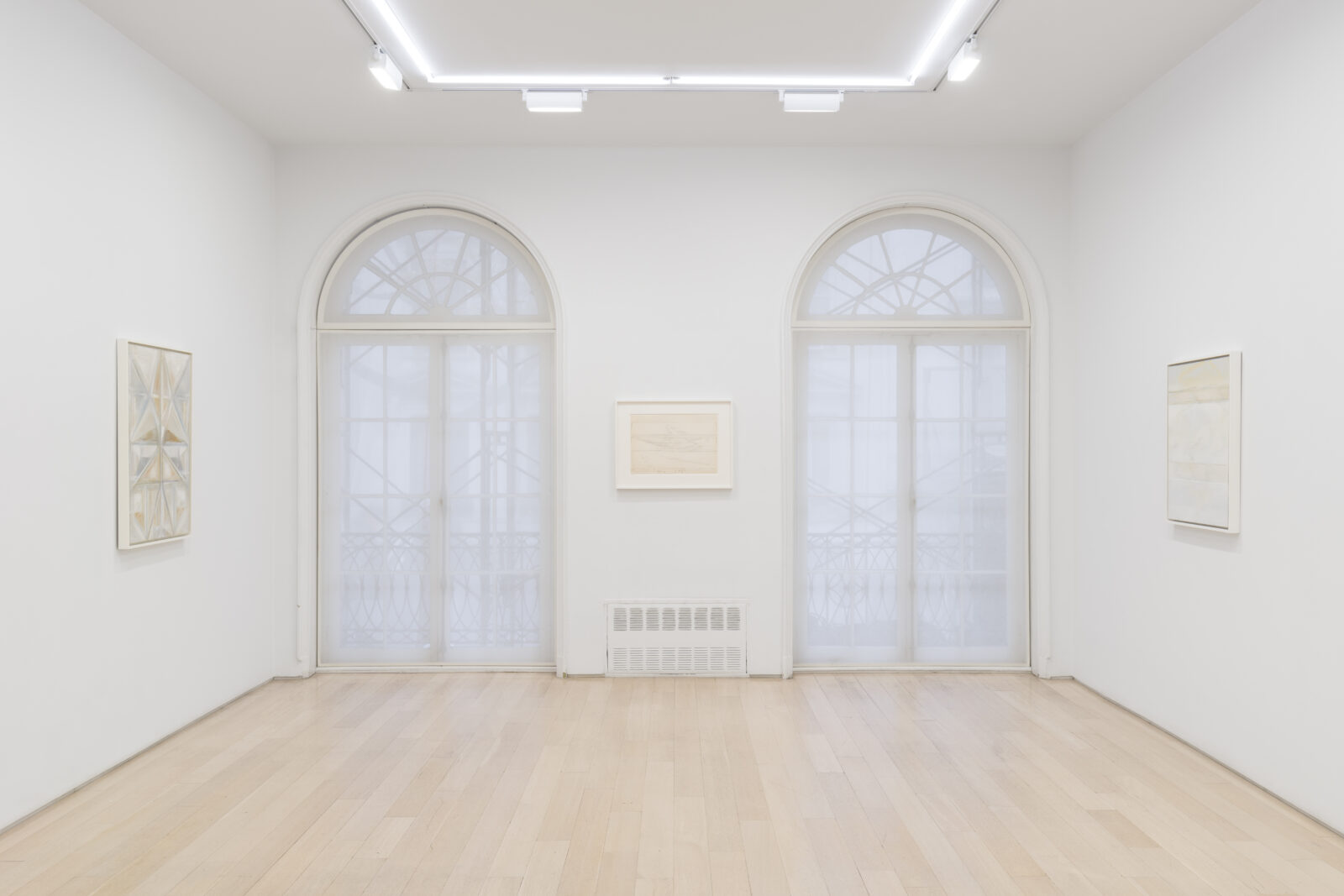
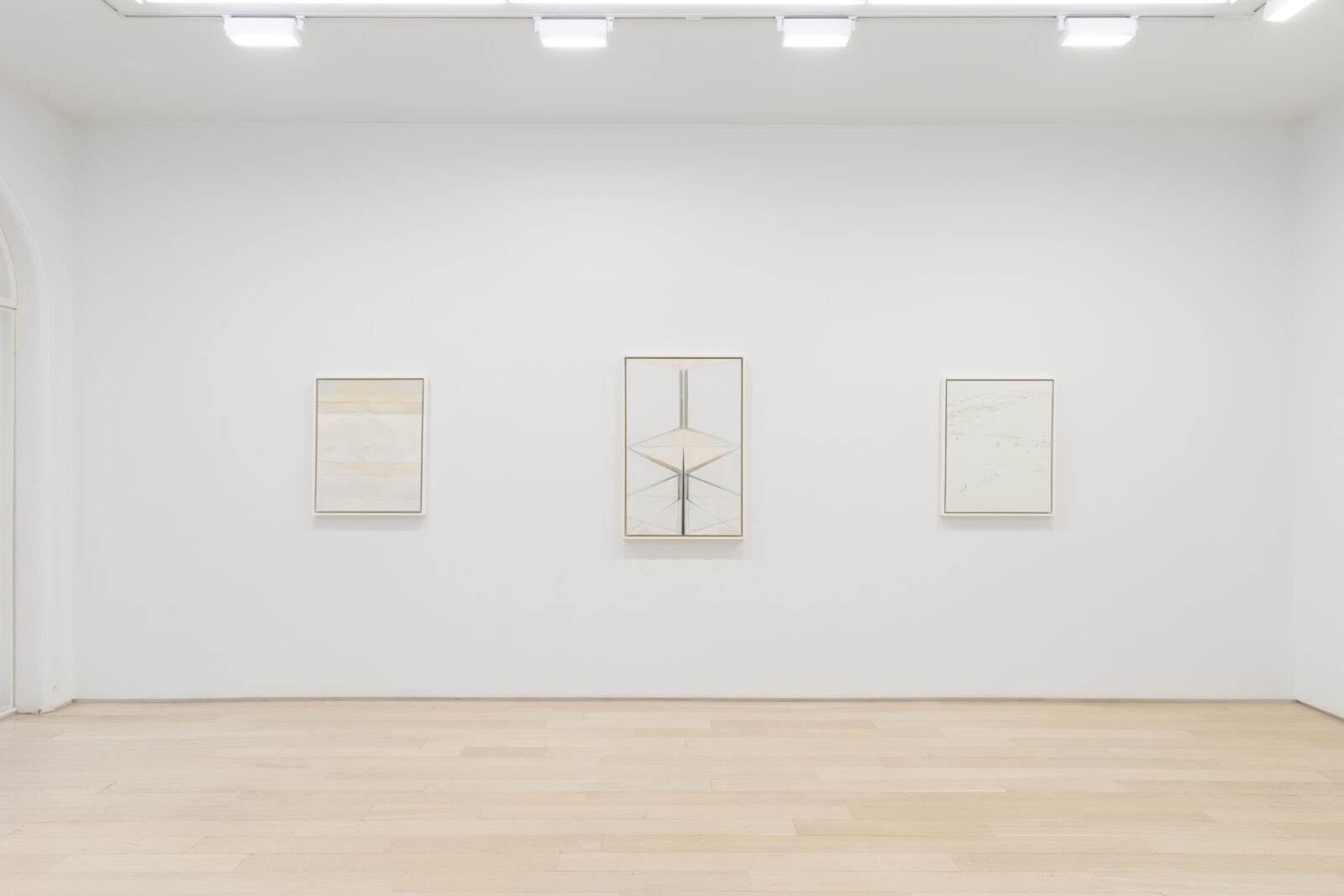
The artist Hedda Sterne (1910-2011) lived for 100 years, creating a wide range of works during her long life. As a young Romanian artist in the 1930s, she made surrealist collages. After fleeing Bucharest during World War II and settling in New York, she produced oil paintings depicting her memories of Bucharest and later anthropomorphized machines of postwar America. She moved on to spray-painted explorations of urban structures; atmospheric portrayals of landscapes and organic forms; and prismatic abstractions of complex geometrical spaces. In the final phase of her artistic career, after losing her vision to macular degeneration, she stopped painting and focused solely on drawing—something she had loved her entire life—creating layered works that the curator Lawrence Rinder described as “seismographic readings of reality… scintillating tremors of the air and of things.” In response to the range and variety of Sterne’s work, some critics have questioned the coherence of her artistic vision. The works on display at Van Doren Waxter this winter (Hedda Sterne: Dreamscapes; 13 November 2025 to 23 January 2026) offered an answer. By focusing attention on the transmutation of Sterne’s work during a particularly significant period of her life, the show revealed how, despite the differences in her work from one decade to the next, it nevertheless emerges in unbroken sequence from within itself to tell the story of one artist’s daily quest to understand the physical and spiritual nature of reality.
Hedda Sterne’s quest happened in her artwork every day: “I realized that whatever I did was a diary.”
Sterne maintained that all of her work was a diary. The actual diary she kept was an unusual one, written in acrylic and markers on squares of canvas she assembled like a quilt and displayed as art (after keeping it on her studio floor and allowing visitors to walk on it as if it were a rug). When examining the trajectory and meaning of Sterne’s work, therefore, it is fitting to consider what was happening in her life at any given time. The period from which the works in this show are drawn, from the late 1960s to 1990, was especially significant, as the 1980s marked a time of change for Sterne. In 1982, Sterne’s four-decade relationship with Betty Parsons and her gallery, The Art of This Century on 57th Street—where she exhibited every few years—ended with Parsons’ death. Needing representation for the first time since 1946, Sterne joined CDS Gallery, owned by Clara Diamant Sujo, a pioneering art dealer and critic, though not necessarily a figure seen as championing the most important work of the twentieth century, as Parsons was. By then in her seventies, Sterne also began working with Ileen Sheppard on her second retrospective at the Queens Museum, which took place in early 1985 (her first was at the Montclair Art Museum in 1977, and her third was at the Krannert Art Museum in 2006). The catalog, which featured reflections by Sheppard and Dore Ashton on the meaning and coherence of her work and photographs that record her aging, makes evident that compiling forty years of her work was a pivotal moment of self-reflection for Sterne.
Not surprisingly, after the retrospective closed in the spring of 1985, Sterne, following her recovery from an illness, described experiencing a change in her personality and characterized herself in letters as being a different person. She had always been interested in philosophical and spiritual texts (she had studied philosophy for a year at the University of Bucharest), with the ideas from those texts influencing her artwork. In the mid-1980s, her reading focused on books that were prompting her to think deeply about reality and perception. On small slips of paper in her studio, she jotted down quotes that speak to her interest in the interpenetration of seemingly dualistic principles, including from Eugene Paul Wigner (“Physical objects and spiritual values have a very similar kind of reality”), Charles Darwin (“[N]ature depends on the consciousness of the human who is observing it”), and Larry Dossey (“Dividing lines in nature between the microscopic/macroscopic, living/nonliving and conscious/unconscious appear increasingly arbitrary if not impossible to define”). Amid this immersion, in 1988 she visited the Asia Society’s groundbreaking exhibition Dreamings: The Art of Aboriginal Australia. Aboriginal Australians have the oldest and most continuous artistic tradition in the world. A manifestation of religious belief, it is based on a concept known as the “Dreaming,” which records the journeys of ancestral beings across the landscape at the beginning of the world; these are thought to underpin everything that exists in the here and now. She found the exhibition “exceedingly interesting and stirring,” saying, “It made me see (in the sense of understanding) a number of essential things.” Given the emphasis in Aboriginal art on the recording of a spiritual journey, I wonder if one of the things Sterne may have begun to see more clearly is that her own artwork was an unending quest not dissimilar from that of Aboriginal artists—to track the underlying patterns of creation.
The transmutation of one series of work into another
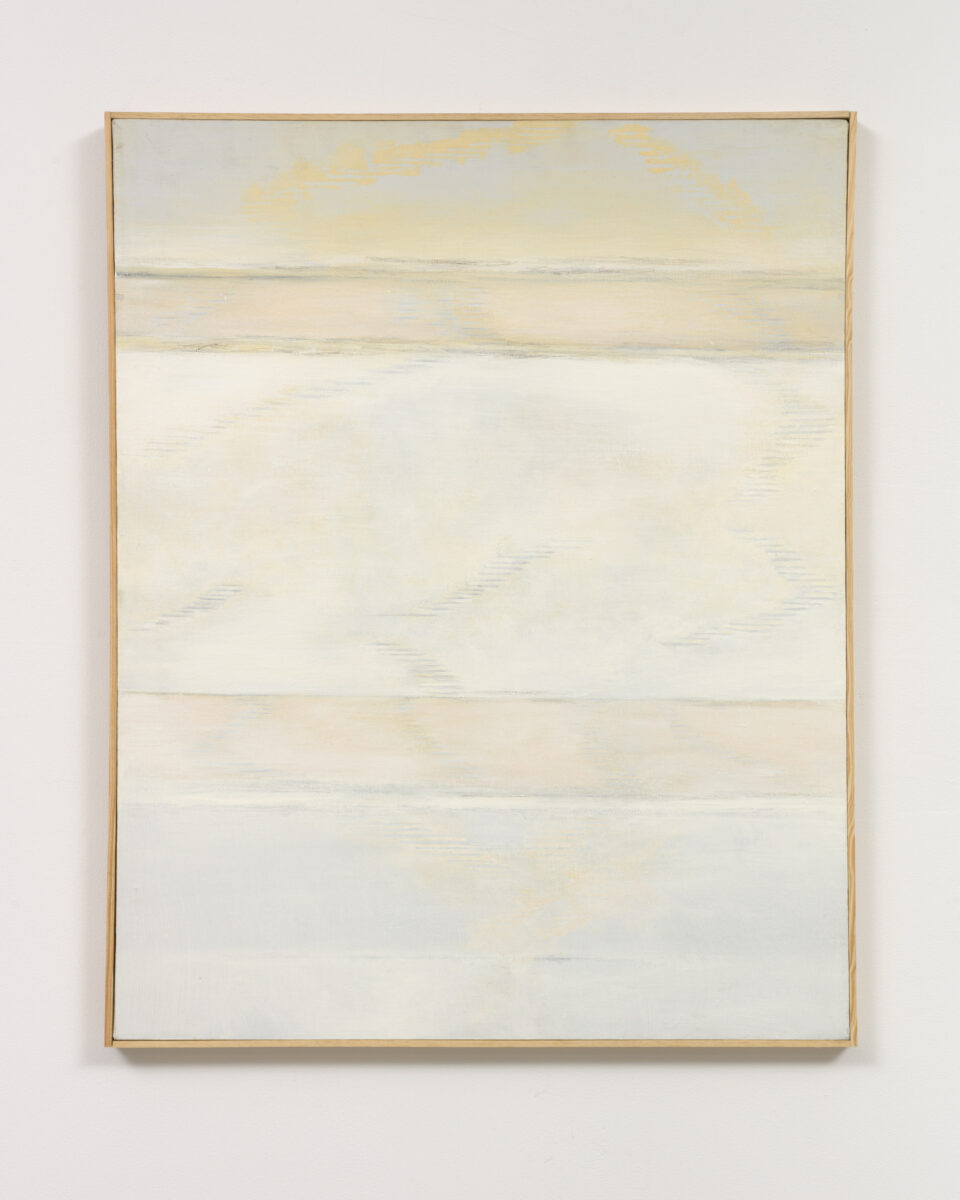
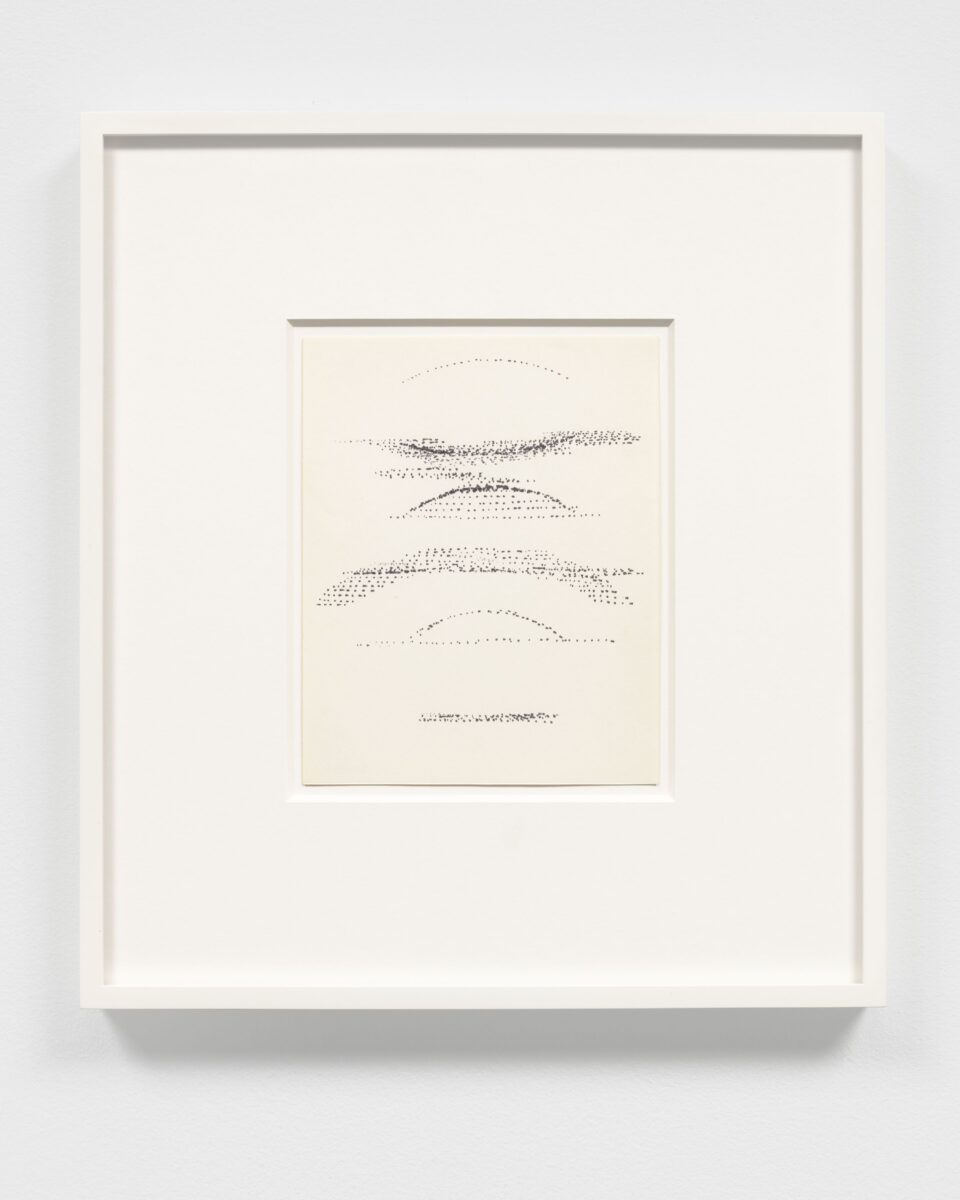
The earliest works in the show are small ink Vertical Horizontal drawings from around 1966, the year Sterne, then in her mid-50s, began meditating daily, a practice she continued until the end of her life and one that informed her artmaking. The generic title Vertical Horizontal is one she also gave to several huge abstract paintings inspired by horizons; these dominated her output throughout the 1960s. In her tiny drawings (measuring barely seven by five inches), Sterne uses a pen to stipple horizontal, linearly composed masses of dots in distinct rows from the bottom to the top of the paper. These arrangements can vary greatly in length, width, and shape. Even within a single Vertical Horizontal drawing, it is not uncommon to see, for example, linear bands of dotted masses in one section that convey the iconographic radial arc of a setting sun above a horizon, which corresponds with imagery in the paintings by the same name, while in another section, the dotted masses suggest tiny human figures migrating toward a meeting ground.
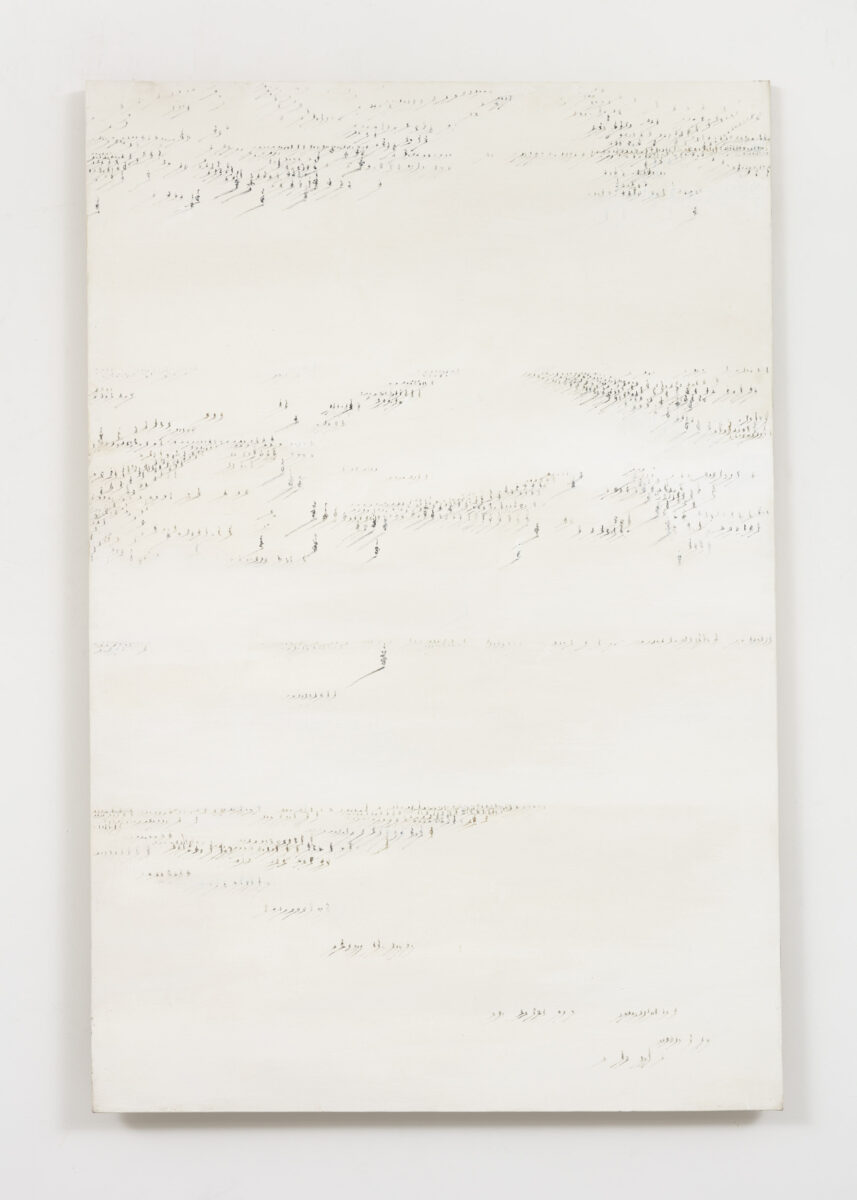
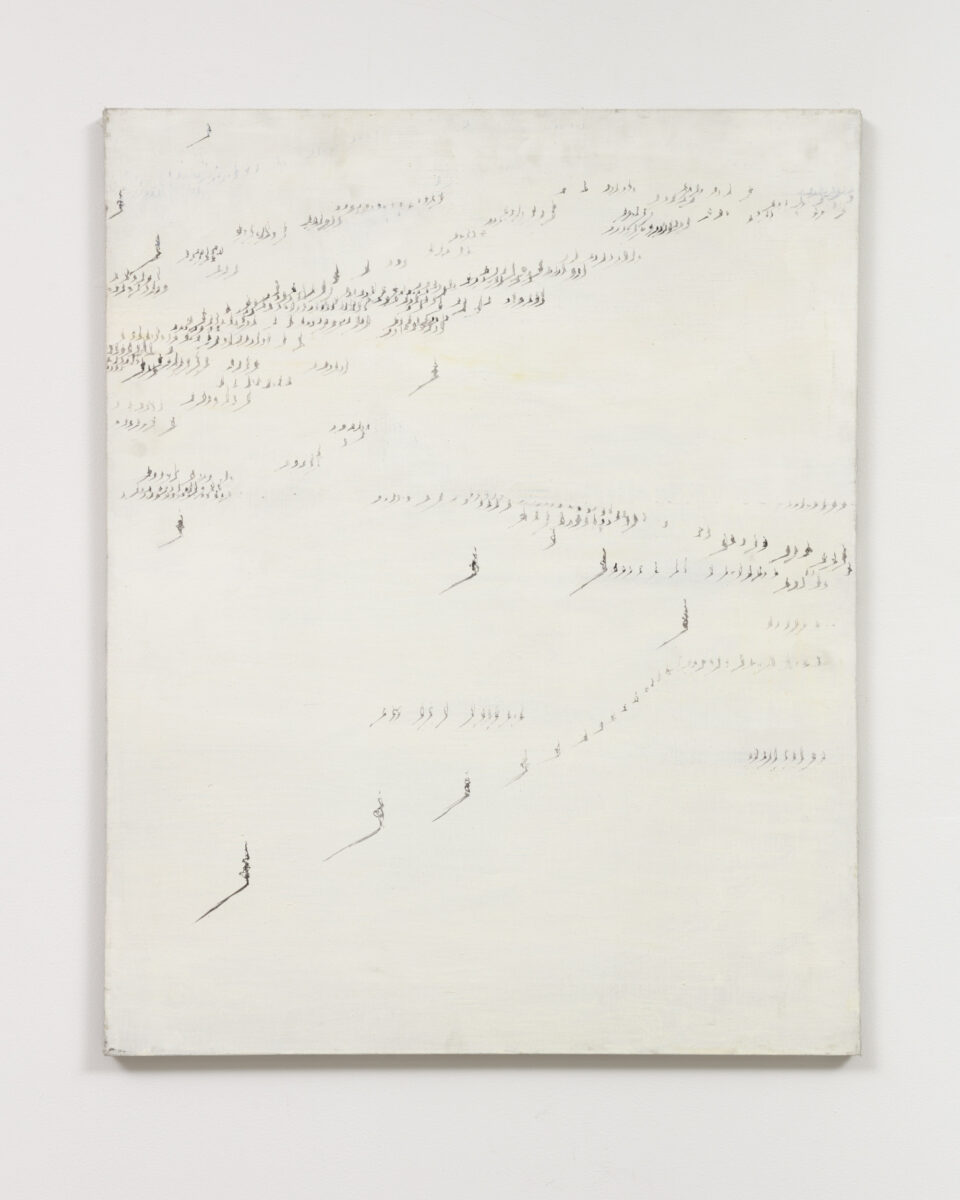
These are closer in spirit to the next works she undertook, her Signs series, five works from which were on display at Van Doren Waxter. These are airy white canvases filled with striated bands of tiny black-gray shapes reminiscent of swarms of people. Thus, although the drawings belong in part to the Vertical Horizontals series, in practice and spirit, they also serve as a bridge to her next subject. In this way, they reveal how, from the beginning to the end of her career, Sterne’s explorations in one area gradually change appearance and almost magically begin to take on a new form, one subject transforming into another, a new series emerging from the old, in a step-by-step journey toward a vision of reality that was only fully revealed in her final ghostly, post-macular pieces.
Hedda Sterne’s Signs
From the start of her career, Sterne was a seeker. One way to interpret the drawings and paintings in her Signs series that begin to emerge from the Vertical Horizontal drawings is to see them as a return to her youthful impulse to be “like a conduit, permitting visions that want to take shape to do so.” As a young artist in prewar Europe, she had access to various modes of artmaking, including classicism, expressionism, and constructivism, but she gravitated toward surrealism, with its connection to the unseen, mystical, and irrational aspects of existence. The Signs series, which art historian Dore Ashton characterized as one of Sterne’s “strangest,” draws its power, like her early surrealist collages, not from her interpretation of the structures and inner scaffolding of optical reality (which had constituted her explorations for several decades) but from her use of a personal, imaginative language to express something ineffable and mysterious about the human condition.
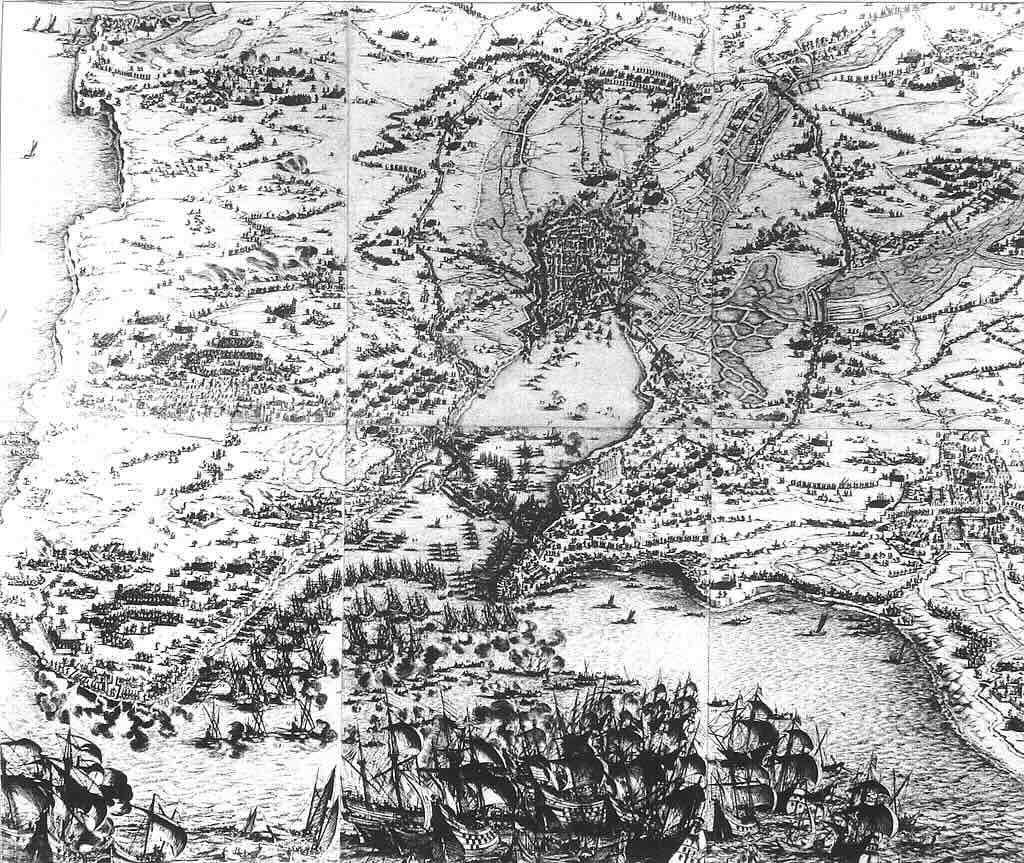
Scattered across small sheets of white paper and canvases are ambiguously shaped marks and their shadows. Ashton described them as resembling “the meticulous crowd scenes of Jacques Callot, magnified,” “trees in an alpine landscape as the German Renaissance painter conceived them,” “troubled waters,” or musical notes. Ashton’s reference to Callot’s crowd scenes resonates most deeply with me, since to my eye the ambiguous marks in the Signs works suggest human figures seen from afar, ant-like in the expanse of space. Some evoke an aerial view of armies gathering on plains, migrating groups heading north, encampments along a river or road, or small clusters of figures standing together and watching. About them, Sterne is quoted as saying she was interested in the “tension between points,” a somewhat dry and technical statement that eludes clear interpretation, though Sterne did amplify her meaning by likening the swarms moving across an otherwise empty canvas to “constellations.” I see them as a visual exploration of the human need (including Sterne’s) to travel, migrate, and journey—whether to undertake a spiritual quest or to set out on an expedition driven by physical survival. (Sterne, who in 1941 fled Bucharest for New York shortly after escaping a roundup and massacre of Jews at her apartment building, was well acquainted with both sets of circumstances.) Perhaps it is because these works are suggestive of such things that they have proved durable in our current age of migration and the backlash it has engendered. Despite their “strangeness,” several of the works from this series at Van Doren Waxter sold. In addition, works from the Signs series are in the collections of major museums, including MoMA.
“Architecture of the Mind”
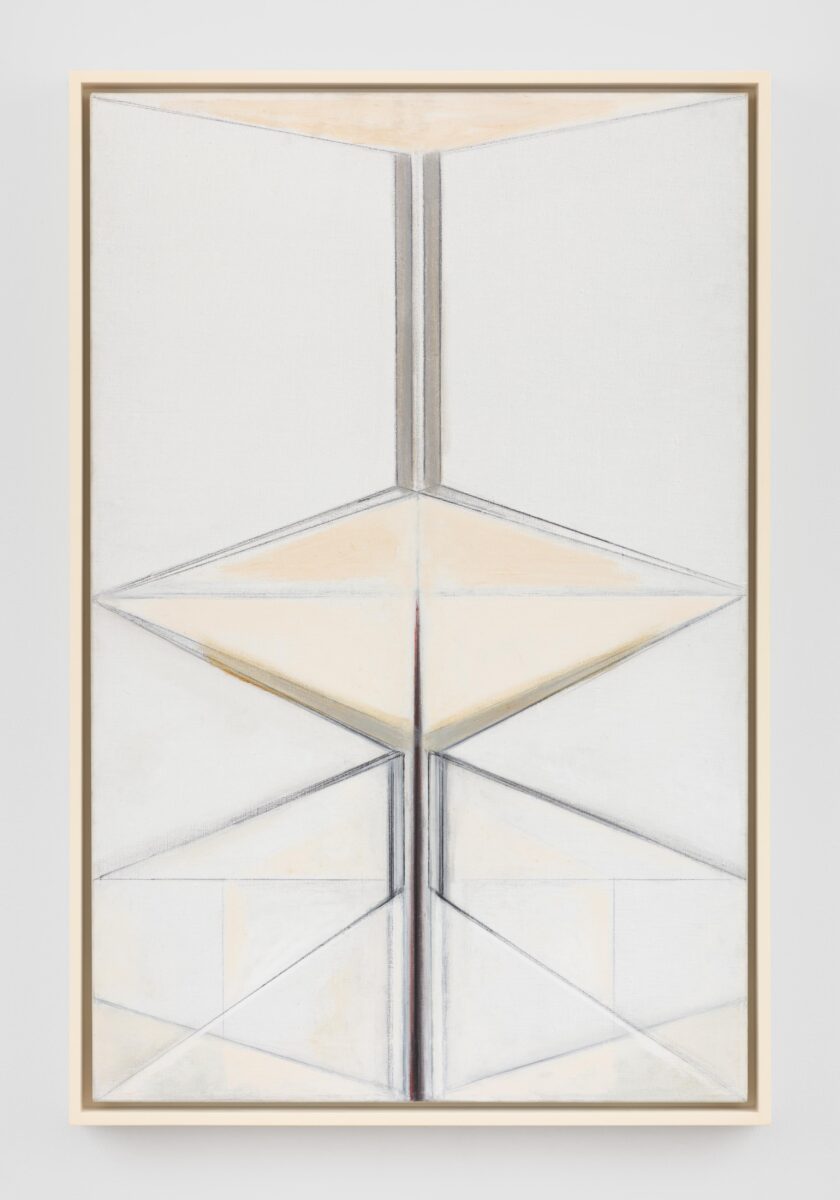
By the early 1980s, Sterne appeared to have exhausted her Signs series, and, simultaneously, the calm, atmospheric lines of her Vertical Horizontal works—where the sense of space feels like a vast monolith—turned into geometric compositions that rely on the conventions of perspective for their effect. Of the many series Sterne did, I have found it hardest to connect with her more geometric canvases, including the Vertical Horizontals and the works from the 1980s, since in their exploration of what Sterne called “the diverse meanings of line” they have often seemed devoid of the layered calligraphy of her earlier work. This changed for me at the Dreamscapes exhibition, which was the first time I’ve had a chance to see Sterne’s works from the 1980s in person. Reflecting the changes in her life, these pieces show a transformation toward greater interiority. Just as in a dream, where a wall in one’s house opens to reveal unseen rooms, it’s as if the flat shapes of Sterne’s Vertical Horizontals have opened into hitherto unknown spaces, where important things that cannot quite be fathomed by consciousness alone are kept. The horizontal lines she used in her Vertical Horizontals to create serene surfaces evocative of horizons and atmosphere now extend back into distant space. While in the Vertical Horizontals the eye moves up and down, in these geometric abstractions the eye moves deep into the illusion of three-dimensional space and back. Sterne referred to these works as “Patterns of Thought” and “Architecture[s] of the Mind.”
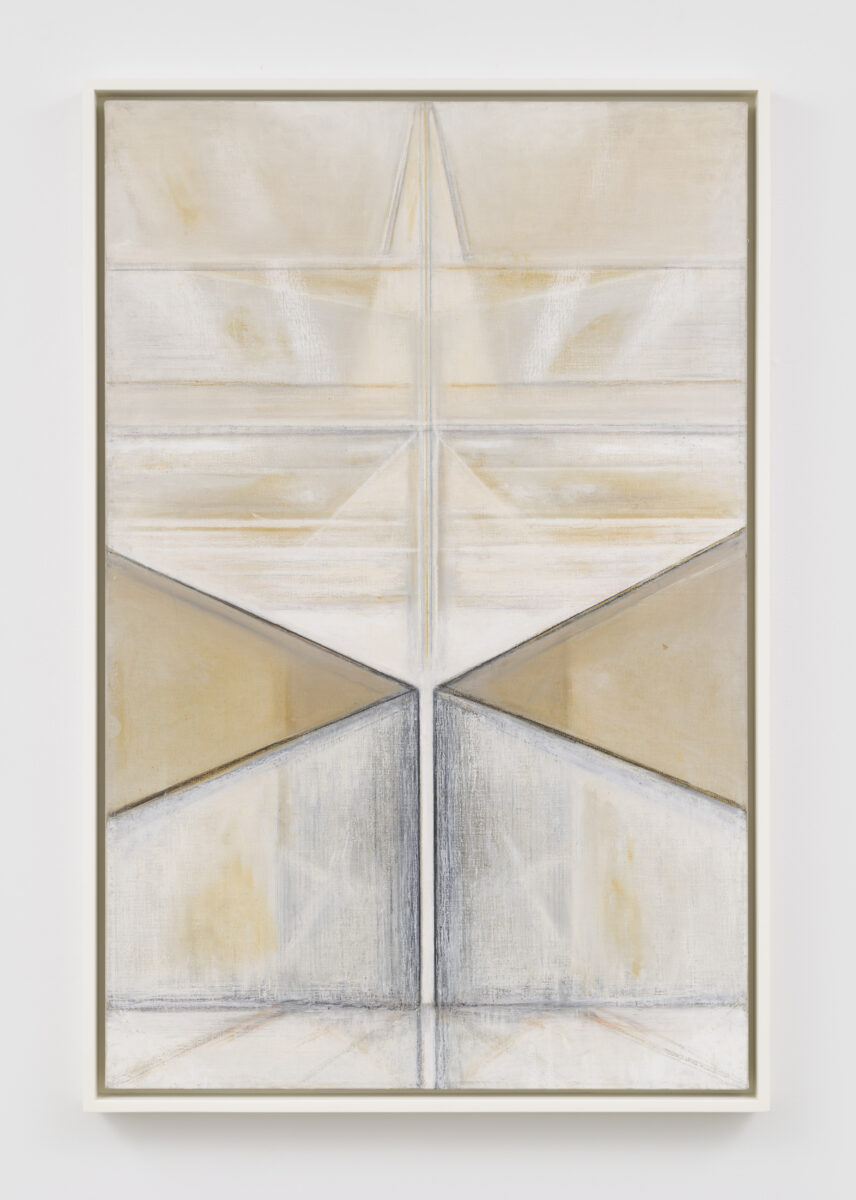
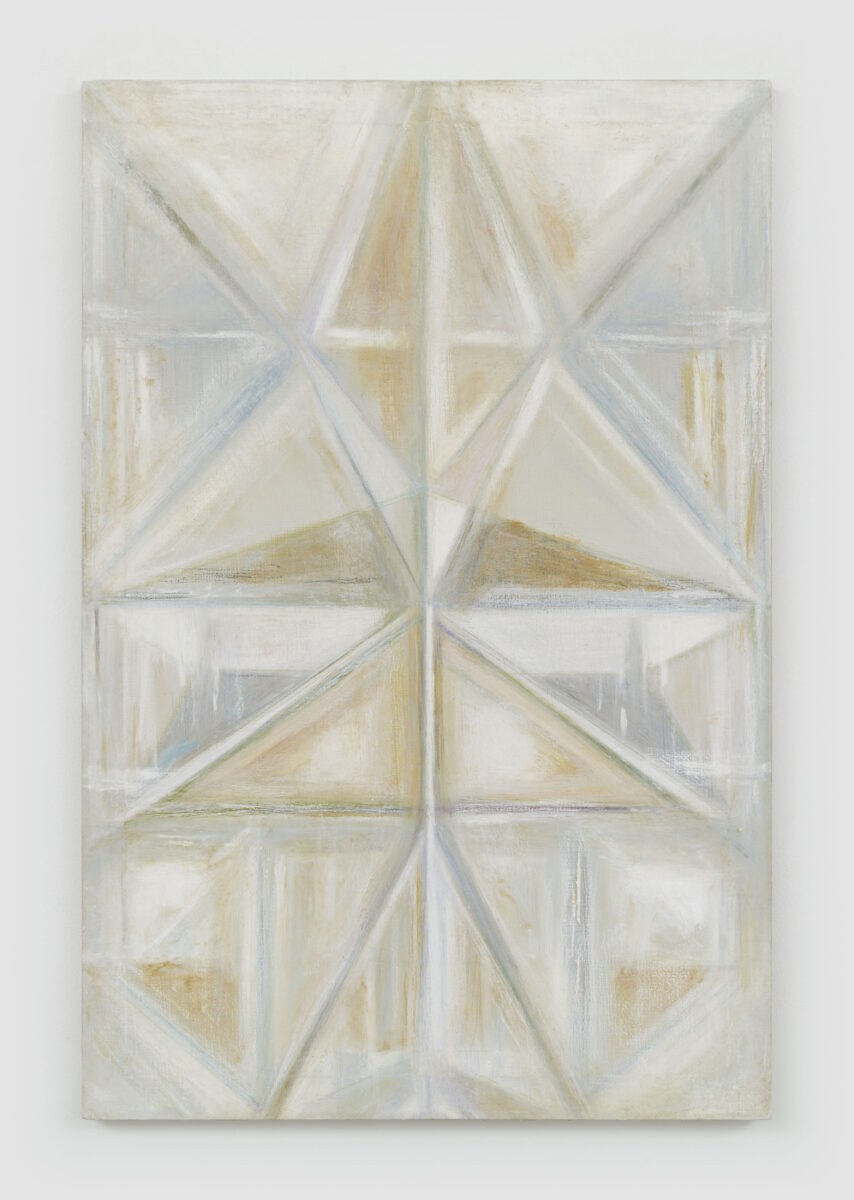
Interestingly, these works, many of which combine drawing and painting, are all untitled. Until this point, Sterne typically didn’t title her drawings, but she usually did name her paintings, even if only somewhat generically (such as Vertical Horizontal or Signs), so the change in approach is notable. It signals that she had experienced a shift in her relationship to or understanding of what she was doing, which is also evident on the canvas. One of the untitled works, from 1988, features oil, pastel, and graphite layered on canvas, which is divided horizontally into three distinct sections from top to bottom and split vertically in half from right to left. The bottom portion of the canvas depicts a section of a pentagonal prism resembling the silhouette of a typical house, comprising vertical walls and a pitched roof. The upper portion, which occupies the largest part of the canvas, shows another pentagonal prism, flipped 180 degrees so that the house’s outline is upside down, with the pitch of the roof slanting upward instead of downward. In the center portion of the canvas, symmetrical acute triangles on the right and left sides mirror one another, their smallest angles pointing like arrows toward the canvas’s vertical midline, not quite touching. Like the geometric abstractions of Wassily Kandinsky, Kasimir Malevich, and Piet Mondrian, Sterne’s careful geometries point to her spirituality: in the layers she has built, one sees iconographic images such as crosses, stars, and rays of light.
Yet just as Sterne’s use of spray paint in the 1950s in her abstract renderings of subjects like roads positioned her uneasily with the abstract expressionists, these works place her imprecisely among geometric abstract artists. The intricate geometric framework of the 1988 painting is intriguing, but it is the content of the prisms that truly distinguishes Sterne’s work: a complex layering of light, tone, symbols, and marks, both foreground and background, that point toward her expression of spiritual truth or yearning. This quietly nuanced complexity led me to perceive these paintings differently—not primarily as formal exercises but as deeply personal communications. In reproduction, it’s difficult to appreciate the subtle ways the canvases have been built up, but viewed in person, these cool, abstract pieces warm with a sense of the artist’s mind embodied in the hand’s work of scumbling, glazing, and subtracting, searching for the light, reinforcing the dark, and giving shape to shadowy things that can be felt and sensed but perhaps not fully understood and articulated.
The pentagonal prism in the lower part of the canvas is vertically bisected by a white bar, cleaving the form into two white quadrilaterals that mirror each other, though not exactly. This creates the illusion of looking into an empty room or at a stage, with a light well on the far wall through which one glimpses something brilliant beyond. The wall is inscribed with dark marks clustering more heavily toward the center on either side of the light bar and where the floor meets the wall. In the bottom section of the canvas, there are reflections that seem to have no true source of light. This contrasts with the upper part, where triangles, stars, and rays of light emanate outward. That chamber in the lower part of the painting, one realizes, exists in the foreground beyond which lies magnificent brilliance—some of that brilliance glimpsed in the light well. It’s hard not to interpret this painting as a depiction of meditation and a belief in transcendence: brilliance that exists outside the confining walls of chambers—of the mind, preconceptions, memories, expectations. Compared to the Vertical Horizontals, it also visually portrays greater dimensionality, greater complexity, greater symmetry, and greater mystery, suggesting that Sterne, in her evolving self, found greater depths to explore—or perhaps, more accurately, to return to.
Sterne’s quest involved exploring a “secret significance in the depths of the ordinary”
After all, a journey rarely, if ever, points only forward; it also points back. While Sterne’s untitled works look toward the future and serve as the foundation for her next explorations, they also return to her past. As Sterne employed at various points in her career the language of surrealism, pop art, abstract expressionism, organic realism, and geometric abstraction, respectively, the surface appearance of her works can vary greatly. Yet what remains consistent across nearly everything she did is an interest in exploring ways of representing what lies beyond conscious and perhaps even optical apprehension, searching for a “secret significance in the depths of the ordinary.” Much of what is happening in her 1988 painting echoes what happened in her earlier works across many styles. There are echoes of a work she did around 1941, for instance. As violence against Jews worsened in Bucharest and Sterne was awaiting passage to New York, she painted an ominous gouache using the language of surrealism that coaxes the eye through a portal in a broken wall toward a distant tear, seemingly of the earth itself, on the horizon. There are echoes too in the series of paintings she did, capturing memories of Romania, after arriving in New York as a refugee in 1941. In one, Open Enclosure, the canvas is divided into eleven distinct quadrilaterals of slightly different sizes, within each of which a little scene unfolds that in some cases involves geometric patterning. Her depictions of New York in the 1940s and ’50s, which she describes as a “gigantic carousel in continuous motion,” are also steeped in geometries that draw the eye toward a luminosity deep in space, as are many of her automatic drawings of organic forms in the 1960s.
What came next: vision loss due to macular degeneration
Sterne herself understood that her work was a continuous whole. Consistent with her view that her work served as a diary, she believed that one painting or drawing led to the next in an interconnected flow, and that her work was most meaningful when viewed sequentially: what she had done next to what she was doing next to what she was about to do. The portals and prismatic spaces of the last works (1990) in the Van Doren Waxter exhibition raise the question of what new depths of artmaking were opening up to Sterne. These are among Sterne’s last works before she began to experience vision loss. This started with cataracts; after having one repaired in 1993, she pronounced her eyesight as being “fair” and, as if anticipating what was to come, wrote in a letter that: “The best [paintings are] the ones that I ‘see’ with my eyes closed.”
The problem was that, along with cataracts, Hedda had macular degeneration. Both are eye diseases most commonly associated with aging. But, while cataracts have a long history of treatment, including in ancient civilizations, and, since the first half of the twentieth century have been corrected as a matter of course, macular degeneration remains without a cure. The modern artist, therefore, experiences the same decline in vision as the historical artist did. Although macular degeneration does not cause complete blindness, it significantly alters a person’s perception of the world. Effects include an inability to see details, reduced contrast sensitivity, loss of color differentiation, and a dark fog blocking the center of vision as the retina deteriorates. The challenges an artist faces in continuing to work are complex, as the struggle to see affects every stage of artmaking, from perceiving visual experiences to hand-eye coordination and self-assessment of a work in progress.
By 1994, Hedda was having intense dreams about painting, but her poor eyesight made it hard to actually paint. By 1996, she was using a magnifying glass to read and was mostly drawing instead of painting. After having a second cataract removed in late December 1996, which gave her a “slight improvement” in her vision, she finally seemed to accept that poor eyesight was now her new normal and moved forward: “My eyes are not at all getting better—but—I read very well with a magnifying glass and I can draw so it has become like a condition I don’t think about anymore.” She gave away her car, destroyed the unfinished paintings she had hoped to finish someday, got rid of her boots, and accepted being mostly housebound during the winter. By 1997, she was legally blind and focused entirely on drawing. Her reading centered on topics of perception, consciousness, and creativity. It included The Pinnacle of Life by biologist Derek Denton, which explores the development of consciousness in humans and animals; Robert Richardson’s biography of Emerson, which she called the “kind of sustaining book one wishes for”; Matisse on Art;and David Abram’s The Spell of the Sensuous: Perception & Language in a More-Than-Human World, which she described as an “important, marvelous book” and “more like a revelation.”
Sterne’s final, post-macular drawings mediate between spirit and matter
From the mid-1980s on, nearly everything Sterne created she left untitled. Among other things, the absence of titles emphasizes dates, the order in which works were made, the diary-like quality of her work. This becomes more noticeable in the last years of her life, when her post-macular drawings begin to include the day, month, and year they were created. Working monochromatically with such materials as pencil, watercolor, wax crayon, and pastels on white paper, she drew egg-shaped masses that can easily be read as heads (perhaps early manifestations of the ghosts that would come to occupy her), overlapping interpretations of subjects from nature such as insects and trees, which she had always had strong feelings about—“I see their [trees’] form like an attitude—,” she wrote in 1994, “resulting in the intense need and desire to reach heights. (The way we humans do . . . rooted too by gravity).” The spiritualized vision of thingness that emerged in 1997 turned to the materialization of spirit in 1998, when she began to draw “ghosts”—faces, as she said, that appear “from a remote past … and want to be portrayed.”
Many artists who lose their sight create a new body of work that seems little connected to their earlier explorations. For example, Thomas Sgouros’s post-macular “landscapes from memory,” although broadly influenced by his previous insights into painting, are entirely different from the carefully observed still lifes he had created before. Other artists, like Wolf Kahn and William Thon, adapted their techniques, bringing fresh optical experiences to familiar subjects. When Sterne lost her vision, it might seem at first glance that, like Sgouros, she produced a new body of work. But in truth, the work she did after Dreamscapes represented neither a rupture nor a continuation of what came before. Instead, it was the next journal entry in the “uninterrupted flux” of her journey, the next expression of her “spiritual itch.” In a 1970 interview, then sixty, Sterne said that the “work of an artist gets its total meaning when he [draws] his last brushstroke. And the last brushstroke has meaning from the first and the first acquires meaning from the last.” Thus, Sterne’s final post-macular works, unfolding as if without end toward a vision she had that was as ineffable as her final ghostly works, suggest that if Sterne belonged to any tradition, it was with a group of women artists, including Hilma af Klimt, Emma Kunz, and Georgiana Houghton, who sought to relinquish their egos and serve as mediators between spirit and matter.
Further Reading

Hedda Sterne’s Recommended Books
Hedda Sterne was a passionate reader. We offer her refreshingly timeless book recommendations as captured in her correspondence with a friend.
Read More
Leave a Comment